


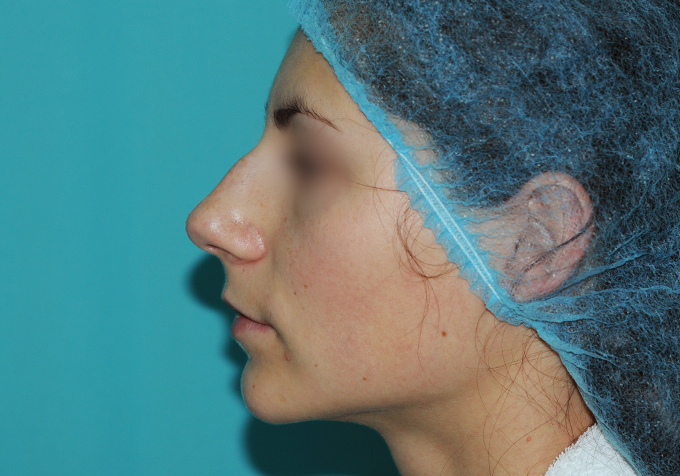

What defects in the tip of the nose can be corrected?
There are the following most common features of the tip of the nose:
● Bifurcated tip. This feature can be adjusted in several ways. The first — with the help of injections of a medicinal product (filler), for example Radiesse or Belotero. The medicinal product is injected into the cavity, which creates a bifurcation effect, and thus smooths it out. Such result is preserved for up to 1–2 years, depending on the drug used. The second method — lipofilling (the cavity at the tip of the nose is filled with the patient’s own fat, which is previously taken from another zone). The duration of the result is up to 2 years. The third one is closed rhinoplasty. At first, the plastic surgeon disconnects the two sides of the tip of the nose, and then stitches them together, shaping an elegant silhouette. If the patient has columella bifurcation, the surgeon picks up a small piece of cartilage (for example, from the septum or auricle) and transplants into the area of the columella, creating a flat surface without bifurcation. The result is maintained for life.
● Bulbous nose. This feature is corrected by closed rhinoplasty — stitching or, if necessary, excision and then stitching of the wing cartilage. Wing cartilage is an extremely delicate part of the nose, so this work requires extreme accuracy and the skill of the surgeon. Excess lateral cartilage is removed, a sophisticated silhouette is shaped. Incorrect stapling may cause asymmetries in the area of the tip of the nose.
● Down-pointing tip. In this case, there are two possible solutions to the problem. The first — without surgery, using Radiesse. The surgeon injects the drug into the area ofthe columella. Forming tissue fibrosis the effect of props and lifting is achieved, and the tip of the nose is lifted. The second is the surgery. The doctor takes the patient’s cartilage tissue (this may be part of the rib, ear or nasal septum), creates the necessary shape using it, and transplants it into the columella region. Thus, the transplanted cartilage serves as a backup for the tip of the nose.
● Asymmetric. Correction of the tip of the nose in this case is possible by non-surgical methods using injections of preparations of hyaluronic acid or calcium hydroxyapatite. But with a displaced septum, a closed technique procedure is recommended.
● Wide. The formation of a more sophisticated and elegant nose is conducted by analogy with the correction of the bulbous nose.
● Upturned. Depending on the situation and anatomical features, surgeons use injection technology or closed technique of the tip of the nose (tissue builds up due to the transplantation of cartilage from the rib or auricle). If the upturned tip of the nose is the result of rhinoplasty, in this case the procedure is performed using the open technique.
Indications
Contraindications
● under 18 and over 70 years of age;
● malignancies;
● pregnancy and lactation;
● tuberculosis;
● blood coagulation disorders;
● general weakness of the body;
● diabetes mellitus.
What results can be achieved?
Using the proprietary technique, Dr. Denishchuk helps his patients get the perfect tip of the nose, which harmoniously fits into the features and proportions of the face. Closed rhinoplasty makes it possible to rejuvenate the patient, relieve psychological discomfort and restore normal breathing with a displaced nasal septum. During the procedure based on the proprietary technique, the doctor works not only with the shape of the tip, but also with the inner structures of the nose.
How to prepare for the surgery?
Rhinoplasty of the tip of the nose requires prior consultation with a plastic surgeon, therapist, a full blood count, a hormone test, an ECG, and a nose imaging (CT).
Fourteen days before the date of surgery, the patient avoids taking aspirin, anti-inflammatory drugs, hormones, and anticoagulants.
Twelve hours before the surgery, the patient stops taking food. In the morning before rhinoplasty, it is prohibited even to drink water, because during anaesthesia muscle relaxation occurs and water can enter the lungs, which entails a number of complications.
What is the rehabilitation process like?
When planning rhinoplasty, it is important to consider that several months after the operation it is necessary to hide the nose from direct sunlight, in case the operation was performed by the open technique to avoid active scar formation. Within a month, patients undergo active nose restoration (they visit a recreation therapist 2–3 times a week to consolidate the result). It is also forbidden to wear glasses for a month, which can deform nasal tissues that have not yet strengthened, and cause additional oedema.
Immediately after reducing the tip of the nose, the patient experiences difficulty breathing, but within a day breathing is restored due to the installation of splints (they expand the airways — breathing is easier). A minor headache is possible. There is also swelling and bruising that disappear within a week.
